




PA vs PC Plastic
-
-
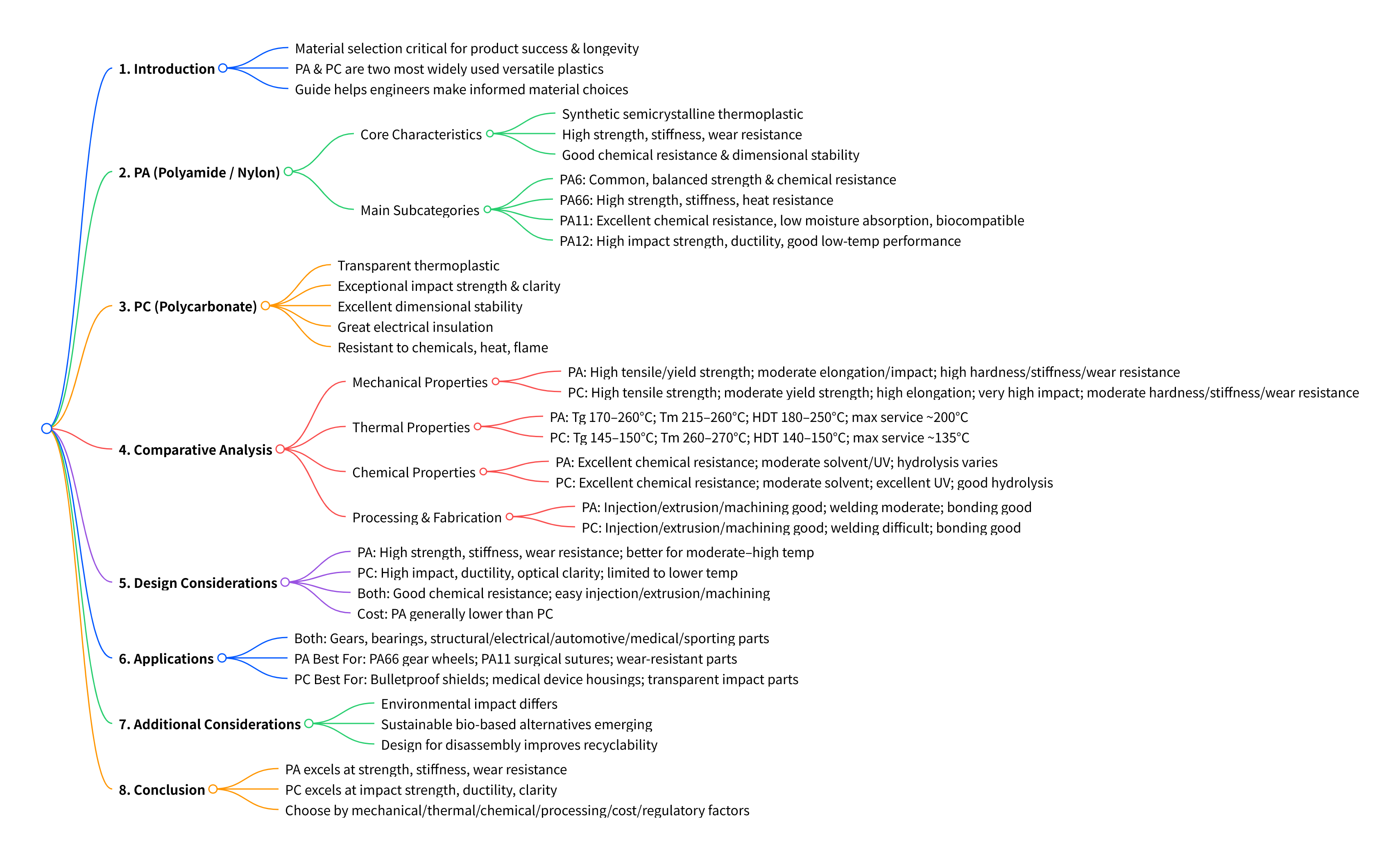
1. Introduction
-
Material selection critical for product success & longevity
-
PA & PC are two most widely used versatile plastics
-
Guide helps engineers make informed material choices
-
-
2. PA (Polyamide / Nylon)
-
Core Characteristics
-
Synthetic semicrystalline thermoplastic
-
High strength, stiffness, wear resistance
-
Good chemical resistance & dimensional stability
-
-
Main Subcategories
-
PA6: Common, balanced strength & chemical resistance
-
PA66: High strength, stiffness, heat resistance
-
PA11: Excellent chemical resistance, low moisture absorption, biocompatible
-
PA12: High impact strength, ductility, good low‑temp performance
-
-
-
3. PC (Polycarbonate)
-
Transparent thermoplastic
-
Exceptional impact strength & clarity
-
Excellent dimensional stability
-
Great electrical insulation
-
Resistant to chemicals, heat, flame
-
-
4. Comparative Analysis
-
Mechanical Properties
-
PA: High tensile/yield strength; moderate elongation/impact; high hardness/stiffness/wear resistance
-
PC: High tensile strength; moderate yield strength; high elongation; very high impact; moderate hardness/stiffness/wear resistance
-
-
Thermal Properties
-
PA: Tg 170–260°C; Tm 215–260°C; HDT 180–250°C; max service ~200°C
-
PC: Tg 145–150°C; Tm 260–270°C; HDT 140–150°C; max service ~135°C
-
-
Chemical Properties
-
PA: Excellent chemical resistance; moderate solvent/UV; hydrolysis varies
-
PC: Excellent chemical resistance; moderate solvent; excellent UV; good hydrolysis
-
-
Processing & Fabrication
-
PA: Injection/extrusion/machining good; welding moderate; bonding good
-
PC: Injection/extrusion/machining good; welding difficult; bonding good
-
-
-
5. Design Considerations
-
PA: High strength, stiffness, wear resistance; better for moderate–high temp
-
PC: High impact, ductility, optical clarity; limited to lower temp
-
Both: Good chemical resistance; easy injection/extrusion/machining
-
Cost: PA generally lower than PC
-
-
6. Applications
-
Both: Gears, bearings, structural/electrical/automotive/medical/sporting parts
-
PA Best For: PA66 gear wheels; PA11 surgical sutures; wear‑resistant parts
-
PC Best For: Bulletproof shields; medical device housings; transparent impact parts
-
-
7. Additional Considerations
-
Environmental impact differs
-
Sustainable bio‑based alternatives emerging
-
Design for disassembly improves recyclability
-
-
8. Conclusion
-
PA excels at strength, stiffness, wear resistance
-
PC excels at impact strength, ductility, clarity
-
Choose by mechanical/thermal/chemical/processing/cost/regulatory factors
-
-
.png)